
NIB
Biotechnological Hub of the NIB (BTH-NIB)
The purpose of the investment project BTH-NIB is the assurance of the appropriate infrastructural conditions for the use of research and developmental opportunities in the fields of operation of the NIB.
Play Video About project Publication
The Science of Rhythms in our lives
Project coordinator: prof. dr. Maruša Pompe Novak
Code: 101305421 - RhythmOfLife
Duration: 1.4.2026-31.3.2028
Website: https://projects.nib.si/rhythmoflife/skupina/noc-raziskovalcev/?lang=en
Project funding: The project received funding from the European Union’s Horizon Europe research and innovation program under the Marie Skłodowska-Curie Grant Agreement No. 101305421.
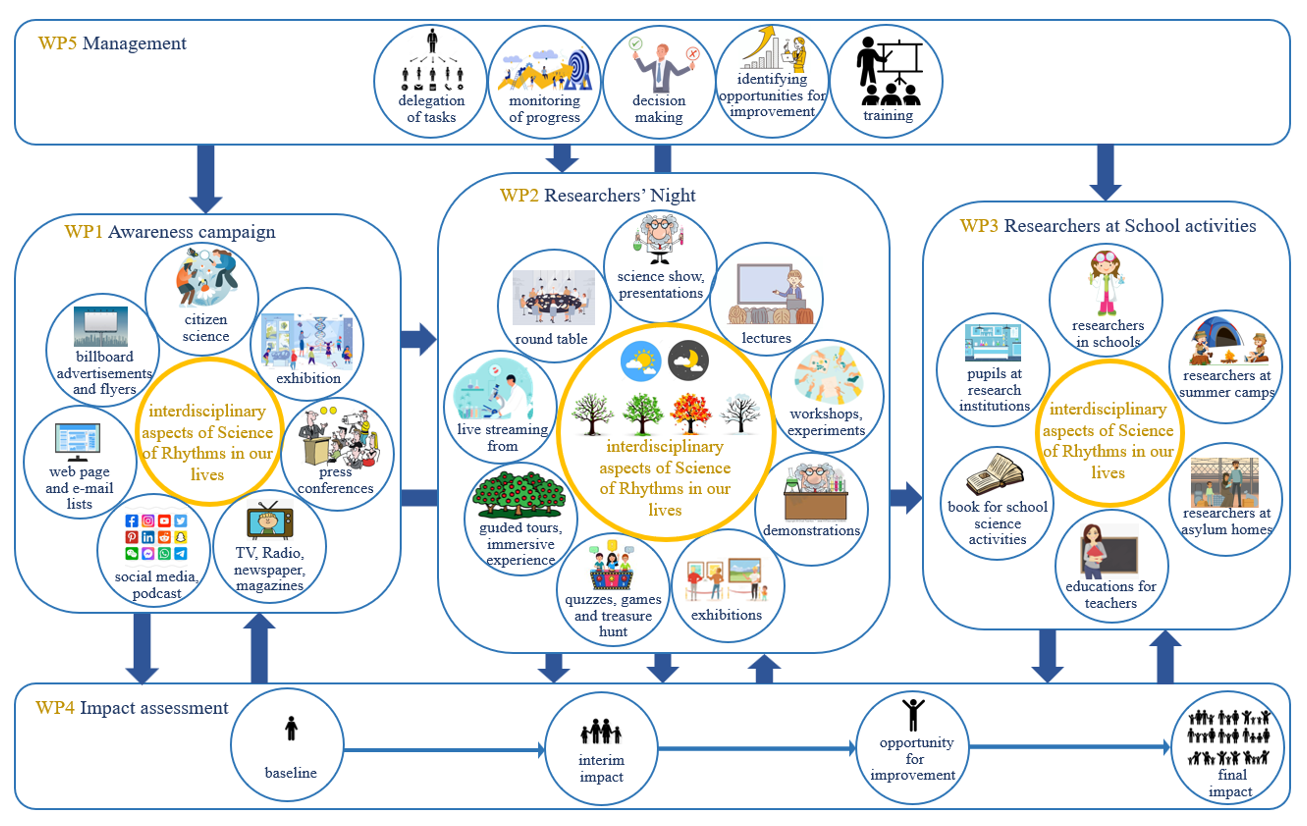
The main goal of the RhythmOfLife project is to foster a closer connection between research and the general public, with a special emphasis on involving families, children, elementary and high school students, teachers, students, and adults, while also focusing on groups with limited access to science, such as older adults, children from socially disadvantaged backgrounds, children and adults with special needs, and migrants. The RhythmOfLife project explores the science of rhythms in nature and human life through engaging formats such as live experiments, strategy games, immersive experiences, and science performances, making science accessible and relevant to a diverse audience. By presenting phenomena familiar to us from everyday life—such as seasonal changes, lunar cycles, and biological rhythms—RhythmOfLife explains the scientific principles behind them and demonstrates how science impacts health, the environment, and society.
The project aims to reach up to 900,000 people through an extensive awareness campaign and attract at least 25,000 participants to Researchers’ Night events across Slovenia in 2026 and 2027. The “Researchers in Schools” activities will directly involve up to 6,700 children in preschools, elementary schools, and high schools. Events will take place across all Slovenian regions, not just in major cities, ensuring broad geographic inclusion. Inclusion is at the heart of the RhythmOfLife project, as reflected in the design of the activities, the diversity of participants, and the composition of the research groups. Vulnerable groups will be actively involved, and activities will be tailored to their needs through collaboration with experts and caregivers.
By promoting scientific literacy and social responsibility, the RhythmOfLife project contributes to greater public awareness of research and innovation, particularly EU-funded research, and its concrete impact on citizens’ daily lives. It sparks interest among young people in careers in STEM and promotes a better understanding of EU policies and programs among the general public.
All departments of the National Institute of Biology participate in the project.

Fast links
Departments and research
Services and products

National Institute of Biology
Večna pot 121, 1000 Ljubljana
Tel: +386 (0)59 232 701
Mail: tajnistvo@nib.si
More about NIB >>


 Scope of NIB's accreditation is given in the Annex to the accreditation certificate and in the List of accredited methods for detection of GMOs and microorganisms – plant pathogens
 Holder of National Standard in the Field of Amount of Substance/Bioanalysis of Nucleic Acids/GMOs and Microorganisms
© 2026- National institute of biology, all rights reserved