
NIB
The purpose of the investment project BTH-NIB is the assurance of the appropriate infrastructural conditions for the use of research and developmental opportunities in the fields of operation of the NIB.
Play Video About project Publication
Investigating ecoacoustic theories in vibrational communities
Project coordinator: Dr. Rok Šturm
Code: J1-70031
Duration: 1. 3. 2026 - 28. 2. 2029
The research project between Slovenian (National Institute of Biology – NIB and Research Centre of the Slovenian Academy of Sciences and Arts - ZRC SAZU) and Czech researchers (Masaryk University in Brno - MU) focuses on the bioacoustic foundations of vibrational communication within insect communities, a critical yet underexplored area in ecological studies. With biodiversity loss and its impacts on ecosystems emerging as a significant global challenge, there is an urgent need for non-invasive methods to monitor ecosystems and the dynamics of ecological processes. While acoustic monitoring has advanced considerably, it remains limited to species producing air- or water-borne sounds, neglecting the majority of terrestrial insect species that communicate using substrate-borne vibrations.
The project investigates the ecological and evolutionary significance of vibrations, drawing from biotremology (a discipline studying animal behaviour in the context of substrate-borne vibrations) and the emerging concept of vibroscape, which encompasses biological, geophysical, and anthropogenic vibrations in a given environment. The main objective is to test key bioacoustic theories within vibrational communities:
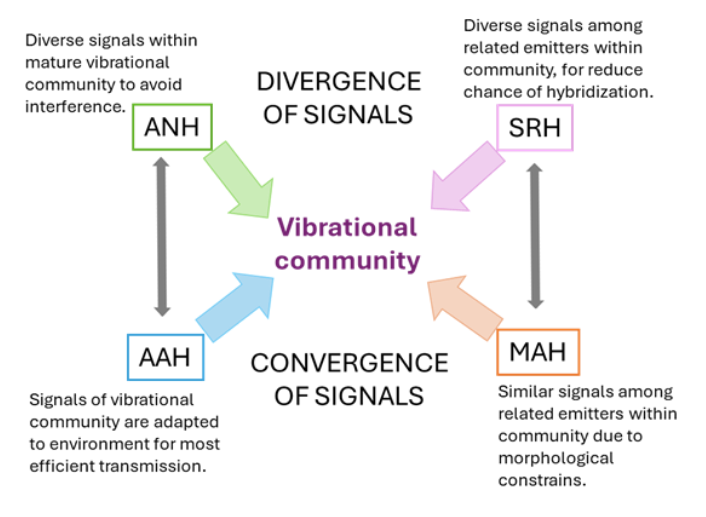
- morphological adaptation hypothesis
- species recognition hypothesis
- acoustic adaptation hypothesis
- acoustic niche hypotheses
These theories, predominantly studied in the acoustic domain, will be examined for their relevance to the vibrational modality and their role in shaping insect communication strategies under unique selection pressures (Fig. 1).
The research program includes:
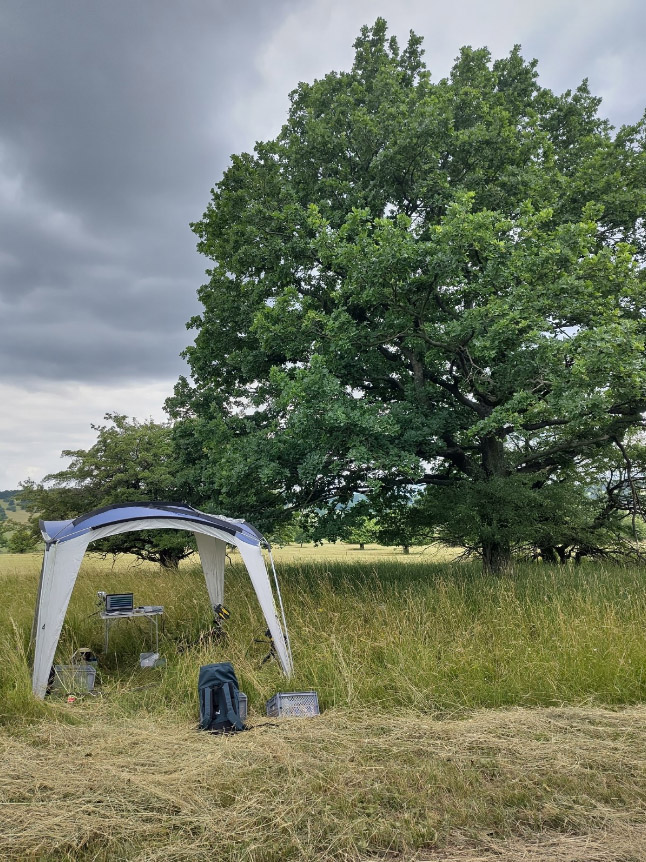
- State-of-the-art vibroscape recordings (Fig. 2) and experimental signal degradation studies across diverse habitats, including species rich grasslands, reed beds, nettle stands and specific trees (willows, apple and pear),
- Assessing how habitat structure influences signal transmission and vibrational community structure.
- Phylogenetic relationships among vibrationally communicating insect species, with two model systems:
- congeneric species of psyllids
- whole vibrational communities found in beforementioned habitats, focusing on hemipterans like true hoppers and psyllids which are ecologically significant and can serve as indicators of environmental changes
- Divergence in vibrational signals among sympatric species to reduce hybridization risks will be checked on
- congeneric species but also
- on whole vibrational communities.
- By integrating vibrational community structure with plant morphological traits, the study will also evaluate the influence of vegetation on signal propagation and vibrational community structure.
- Finally, vibrational community structure will also be examined in dominant frequency range and overlapping of signals in time and frequency domain.
The project’s outcomes include
- advancing our understanding of vibrational communication’s ecological role
- generating comprehensive data on vibrational signal diversity and community phylogenetics.
- critical tools for conservation and contribute to addressing the biodiversity crisis by facilitating passive and non-invasive monitoring of ecosystems in future.
- promoting interdisciplinary collaborations and public engagement, showcasing the hidden vibrational world of insect communication and its importance for ecological balance.
The research project J1-70031 is financed by the Slovenian Research and Innovation Agency (ARIS) from national budget.
Basic information about the project (SICRIS)
Fast links
Departments and research
Services and products

National Institute of Biology
Večna pot 121, 1000 Ljubljana
Tel: +386 (0)59 232 701
Mail: tajnistvo@nib.si
More about NIB >>


 Scope of NIB's accreditation is given in the Annex to the accreditation certificate and in the List of accredited methods for detection of GMOs and microorganisms – plant pathogens