08
Dec
Scientists Discover New Spider Genus and Species in Madagascar, Reshaping Understanding of Spider Evolution


Madagascar’s reputation as a global biodiversity hotspot has grown even stronger with the discovery of a new spider genus and species from the montane forests of Marojejy National Park.
The research, led by Matjaž Kuntner of the National Institute of Biology (Slovenia), is published on 5 December 2025 in Insect Systematics and Diversity.

Osmooka aphana, female of a newly described species in Madagascar.
The discovery began far from Madagascar—in San Francisco—where Kuntner examined a museum specimen collected in 2005 from Marojejy. The spider didn’t match any known family. Together with Jason Bond of the University of California, Davis, Kuntner imaged the mysterious male and searched for comparable species among the world’s more than 50,000 described spiders. A breakthrough came when the corresponding female was uncovered in the Smithsonian collections, originating from a 1993 expedition by Jonathan Coddington and colleagues.
To find fresh material, Kuntner and collaborators from the National Institute of Biology and ZRC SAZU ran expeditions to northern Madagascar in 2022 and 2024, working closely with Malagasy partners. Despite intensive fieldwork, only eight adults are known across all museum and field collections—underscoring the rarity of the species.
The team formally described the new genus and species as Osmooka aphana. The genus name is derived from a Slovene term meaning “eight-eyed,” while the species name, from the Greek aphanés (“unseen,” “unknown,” “obscure”), highlights both the difficulty of discovery and the spider’s poorly understood biology.
A major scientific surprise emerged from the phylogenomic work. Using subgenomic data, the researchers identified the closest known relative of Osmooka as Paraplectanoides, an Australian ovoid-nest spider. Morphological analyses supported placing both genera within the previously proposed family Paraplectanoididae—now expanded beyond a single genus.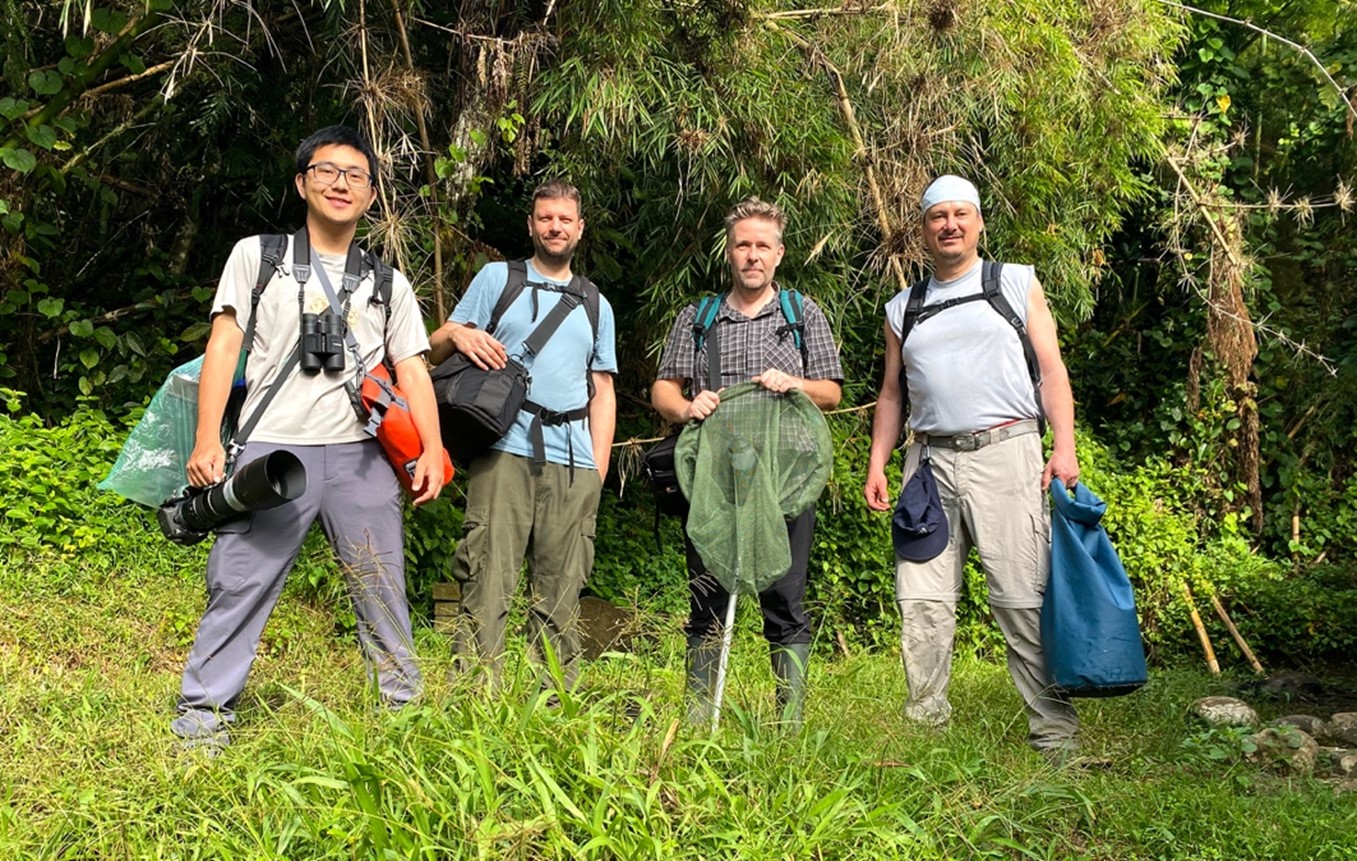
The team from Slovenia conducting fieldwork in Madagascar in 2022 (left to right: Kuang-Ping Yu, Matjaž Gregorič, Matjaž Bedjanič, Matjaž Kuntner).
This unexpected Madagascar–Australia connection raised a classic biogeographic question: could these spiders trace their roots back to the ancient southern supercontinent Gondwana? Divergence dating analyses ruled out this scenario, showing that the common ancestor of the two genera lived only about 57 million years ago—far more recent than the 130-million-year-old breakup of Gondwana. Instead, the disjunct distribution likely reflects still-unknown Cenozoic dispersal events.
“The discovery of Osmooka aphana highlights not only Madagascar’s extraordinary biodiversity, but also how much of it remains undescribed,” said Kuntner. “This species doesn’t just add a new genus to science—it forces us to rethink family-level spider classification and raises new questions about how these lineages dispersed across continents.”
The full study is available open access in Insect Systematics and Diversity: https://academic.oup.com/isd/article/9/6/ixaf050/8369272.
For more information, please contact:
- NIB office: Žiga Cerkvenik (This email address is being protected from spambots. You need JavaScript enabled to view it.)
- The lead author: Dr. Matjaž Kuntner (This email address is being protected from spambots. You need JavaScript enabled to view it.)
Photos: copyright M. Kuntner