
Projects
The purpose of the investment project BTH-NIB is the assurance of the appropriate infrastructural conditions for the use of research and developmental opportunities in the fields of operation of the NIB.
Play Video About project Publication
Involvement of citizen science in the study of competition in coexisting top predators using advanced monitoring techniques
Project coordinator: Assist. prof. dr. Al Vrezec
Code: O1-60010
Duration: 1.10.2025 - 31.12.2026
The project is related to the ongoing research project J1-60010 Evolutionary effects of competition in coexisting apex predator populations (CO-STRIX), which is investigating the previously unknown effects of the coexistence of predators, using two owls, the Tawny (Strix aluco) and the Ural Owl (Strix uralensis), as model species. Preliminary data suggest that intense interspecific interactions due to altered selection pressures promote microevolutionary changes in body size in these competing species. The main hypothesis of the research project is that competition with the Tawny Owl in sympatric populations of the Ural Owls causes an increase in body size in the latter in order to maintain dominance in space and in the use of nest sites. The aim of the research project is to investigate all possible mechanisms that could cause such size differentiation in owls. The aim of this project is to implement the planned content related to citizen science and to upgrade it for testing the microevolutionary hypothesis, which assumes that selection at the local level due to competitive dominance leads to heritable microevolutionary changes in which larger individuals have an advantage. The following activities are therefore planned as part of this project: (1) capacity building with workshops to train citizen scientists (bird ringers), (2) field sampling with bird ringers, (3) field testing of radio frequency identification (RFID) in birds and establishment of the concept of smart research nest boxes that can also be used by interested citizens for data collection, (4) setting up a project website to inform the participating citizen scientists and the general public, (5) preparing popular science contributions, and (6) producing a joint original scientific paper with the participating citizen scientists as co-authors. The project includes multi-day field workshops in which citizen scientists trained as bird ringers and affiliated with the Slovenian Bird Ringing Centre of the Slovenian Museum of Natural History are additionally trained to trap, ring and collect biometric data on Tawny and Ural Owls in selected areas of Slovenia. This is a research potential that could provide data on the frequency of visits of individual owls to nesting sites, with a focus on interspecific interactions, which is one of the main research objectives of the CO-STRIX project. To investigate interspecific interactions related to competition for nest sites, we are developing an automated system to record the arrival of individual owls at nest sites using an RFID system at the National Institute of Biology in collaboration with an external partner. As part of the project, the system will be tested in the field with the help of citizen scientists.
Basic information about the project (SICRIS)
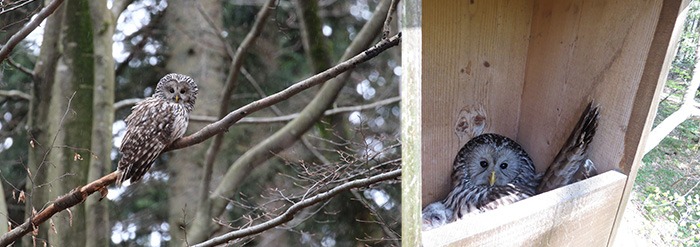
Photo: Maks Sešlar and Al Vrezec
Fast links
Departments and research
Services and products

National Institute of Biology
Večna pot 121, 1000 Ljubljana
Tel: +386 (0)59 232 701
Mail: tajnistvo@nib.si
More about NIB >>


 Scope of NIB's accreditation is given in the Annex to the accreditation certificate and in the List of accredited methods for detection of GMOs and microorganisms – plant pathogens