
Projects
Biotechnological Hub of the NIB (BTH-NIB)
The purpose of the investment project BTH-NIB is the assurance of the appropriate infrastructural conditions for the use of research and developmental opportunities in the fields of operation of the NIB.
Play Video About project Publication
Understanding and facilitating friendships: Mechanistic modelling of plant-microbe interactions to increase the stability and performance of synthetic communities
Project coordinator: Jan Zrimec
Code: J4-70167
Duration: 1.3.2026-28.2.2029
Agricultural crops perform well below their maximum potential and improving their performance is a key step toward ensuring food security and sustainability. To accomplish this, we must expand our understanding of plant ecosystems, which comprise communities of microorganisms, such as bacteria and fungi. As there is a clear functional connection between microbes and plant performance, an important strategy is to engineer synthetic microbial communities to augment the microbial functions of natural plant ecosystems. Our research objective is thus to study the potato phytobiome and improve our understanding of how microbes affect potato growth and stress response. We will develop and apply advanced mathematical modelling approaches to model the potato plant and its phytobiome, taking advantage of large-scale omics data. Based on these models and newly-acquired knowledge, we will design synthetic communities and experimentally validate their performance and stability in a circular design-build-test-learn fashion.
Plants and microbes interact via cellular metabolism, a set of enzyme-catalysed reactions that allow organisms to grow, reproduce and respond to their environments. Plants also exhibit interplay between growth and defence via complex signalling and regulatory networks, and microbes produce compounds that either positively or negatively affect plant growth and stress resilience. For instance, beneficial endophytes that colonize internal plant tissues were shown to be useful as alternatives to chemical pesticides and fertilisers under field conditions. The engineering of microbial synthetic communities is thus an increasingly popular approach to understand the function and composition of minimal functional communities affecting plant performance. However, field applications have demonstrated that present designs perform only under a narrow range of conditions, with low robustness across different environmental settings. To improve the situation, we hypothesise that by learning from beneficial symbiotic interactions of potato with endophytes, we can improve community design toward increased stability and performance. By finding host- and microbe-promoting mechanisms, we can increase the likelihood of designing robust communities due to increased support for and from the plant, resulting in the development of reliable plant protection products.
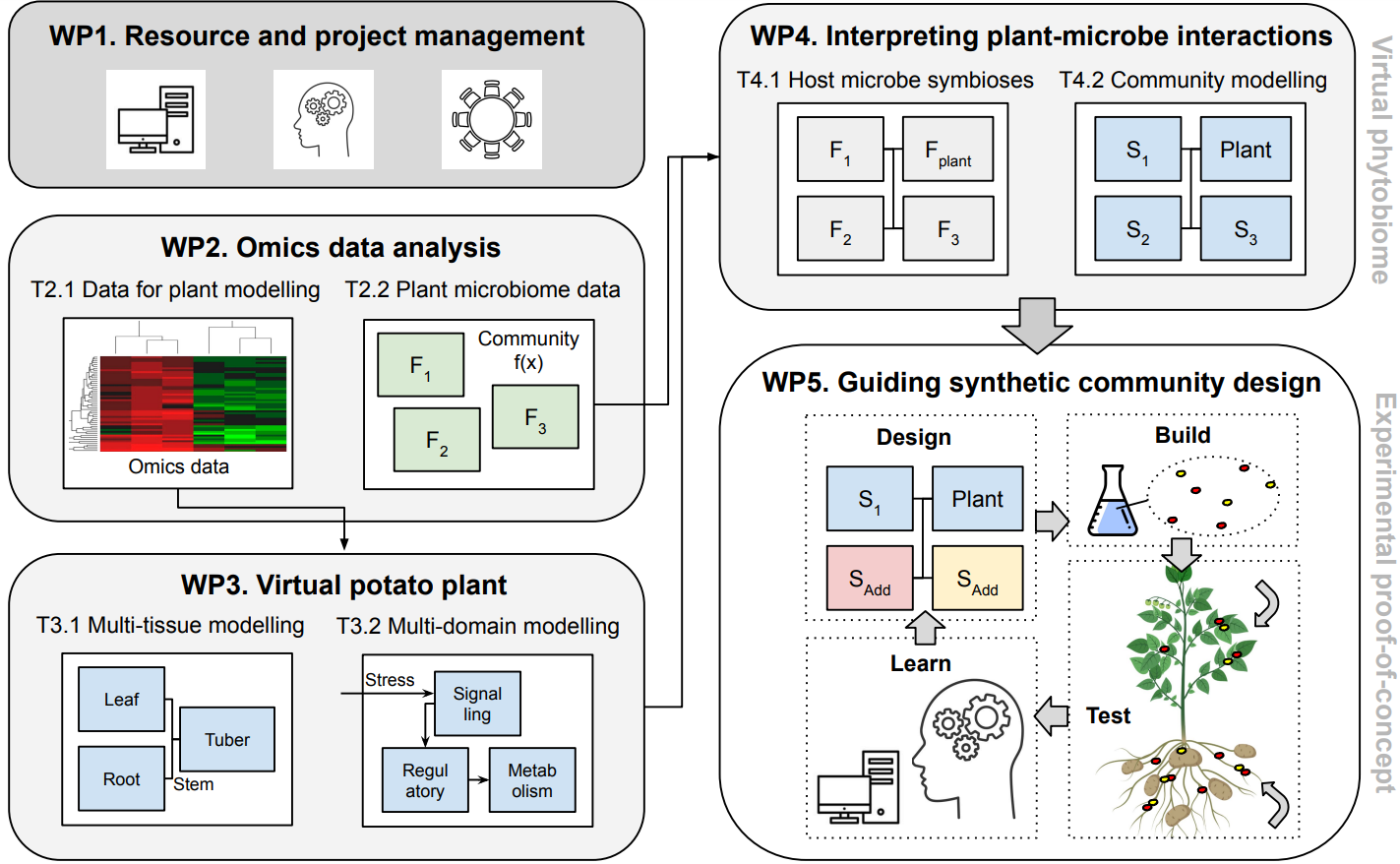
The proposed project is organised into five work packages (WP). The first WP involves resource and project management, and in WP2, we will acquire, process and analyse plant and microbiome data required for modelling. To accurately capture potato growth and defence characteristics, in WP3 we will integrate multiple modelling paradigms including metabolism, signalling and gene regulation into a multi-domain model across key tissues, constructing a 'virtual plant'. In WP4, we will expand the developed framework to multi-species community modelling, a 'virtual phytobiome',that can accurately simulate and characterise plant-microbe interactions. In WP5, we will prototype a procedure based on the models to design improved synthetic communities.
The proposed interdisciplinary systems approach can help us understand the interactions within phytobiomes, and the principles of plant-associated microbial community composition and function. Our focus on crop species enables the direct translation of new-found knowledge to the agronomically important goals of improving crop yield, quality, and environmental stress tolerance under field conditions. By identifying microbes with major effects on metabolic and phenotypic outcomes, we have a high possibility of developing breakthrough crop protection strategies with improved field-specific responses, contributing towards sustainable agriculture and healthier soils.
The project thus promotes national, EU and global directives on food security and sustainability, and is of exceptional scientific, societal and economic importance.
SICRIS
Plants and microbes interact via cellular metabolism, a set of enzyme-catalysed reactions that allow organisms to grow, reproduce and respond to their environments. Plants also exhibit interplay between growth and defence via complex signalling and regulatory networks, and microbes produce compounds that either positively or negatively affect plant growth and stress resilience. For instance, beneficial endophytes that colonize internal plant tissues were shown to be useful as alternatives to chemical pesticides and fertilisers under field conditions. The engineering of microbial synthetic communities is thus an increasingly popular approach to understand the function and composition of minimal functional communities affecting plant performance. However, field applications have demonstrated that present designs perform only under a narrow range of conditions, with low robustness across different environmental settings. To improve the situation, we hypothesise that by learning from beneficial symbiotic interactions of potato with endophytes, we can improve community design toward increased stability and performance. By finding host- and microbe-promoting mechanisms, we can increase the likelihood of designing robust communities due to increased support for and from the plant, resulting in the development of reliable plant protection products.
The proposed project is organised into five work packages (WP). The first WP involves resource and project management, and in WP2, we will acquire, process and analyse plant and microbiome data required for modelling. To accurately capture potato growth and defence characteristics, in WP3 we will integrate multiple modelling paradigms including metabolism, signalling and gene regulation into a multi-domain model across key tissues, constructing a 'virtual plant'. In WP4, we will expand the developed framework to multi-species community modelling, a 'virtual phytobiome',that can accurately simulate and characterise plant-microbe interactions. In WP5, we will prototype a procedure based on the models to design improved synthetic communities.
The proposed interdisciplinary systems approach can help us understand the interactions within phytobiomes, and the principles of plant-associated microbial community composition and function. Our focus on crop species enables the direct translation of new-found knowledge to the agronomically important goals of improving crop yield, quality, and environmental stress tolerance under field conditions. By identifying microbes with major effects on metabolic and phenotypic outcomes, we have a high possibility of developing breakthrough crop protection strategies with improved field-specific responses, contributing towards sustainable agriculture and healthier soils.
The project thus promotes national, EU and global directives on food security and sustainability, and is of exceptional scientific, societal and economic importance.
SICRIS
Fast links
Departments and research
Services and products

National Institute of Biology
Večna pot 121, 1000 Ljubljana
Tel: +386 (0)59 232 701
Mail: tajnistvo@nib.si
More about NIB >>


 Scope of NIB's accreditation is given in the Annex to the accreditation certificate and in the List of accredited methods for detection of GMOs and microorganisms – plant pathogens
 Holder of National Standard in the Field of Amount of Substance/Bioanalysis of Nucleic Acids/GMOs and Microorganisms
© 2023- National institute of biology, all rights reserved